
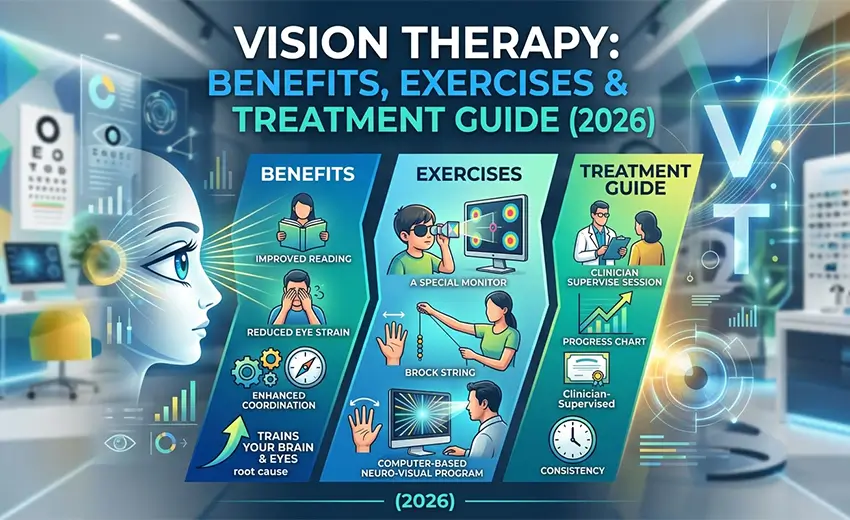
Vision therapy is a structured, clinician-supervised program of eye and brain exercises designed to correct or improve specific visual skills and processing. Unlike glasses or contact lenses that simply compensate for refractive errors, vision therapy trains the visual system to work more efficiently, addressing the root cause of many vision problems.
If you or your child struggles with reading difficulties, eye strain, double vision, or poor eye coordination, vision therapy may be the solution your optometrist has not yet discussed with you. This guide covers everything you need to know, from how vision therapy works to the conditions it treats and the exercises involved.
What Is Vision Therapy?
Vision therapy (also called vision training or orthoptic therapy) is a personalized treatment program prescribed and supervised by an optometrist. It uses a series of eye exercises, optical tools such as prisms and lenses, and specialized activities to retrain the visual system.
The goal is to improve the communication between the eyes and the brain a process known as visual processing. Many patients who struggle with learning, reading, sports performance, or daily tasks have underlying visual deficits that standard eye tests do not detect.
Vision therapy is not a one-size-fits-all approach. Each program is tailored to the patient’s specific diagnosis following a comprehensive binocular vision assessment.
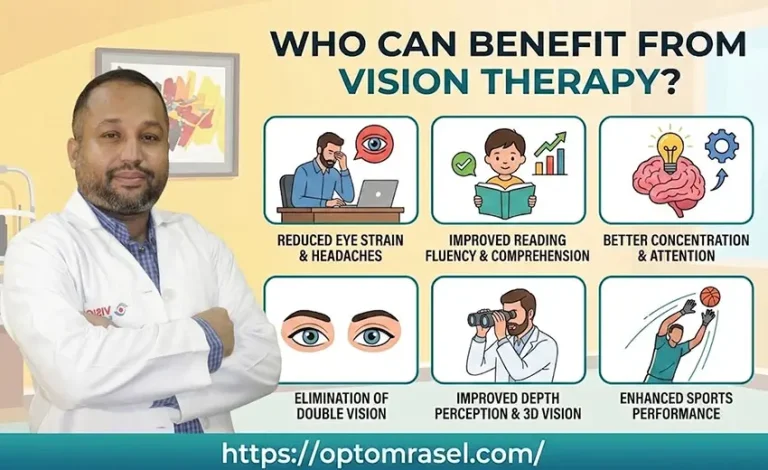
“Vision therapy is designed to improve how the eyes and brain work together. With proper diagnosis and individualized treatment, many patients experience significant improvements in visual performance and daily activities.” Dr. Mohammad Abdul Auwal Rasel, Optometrist & Vision Therapy Specialist, Bangladesh
How Vision Therapy Works
The visual system is not fully developed at birth. It continues to mature through childhood and can be retrained at any age through targeted neurological exercises. Vision therapy leverages this brain plasticity the ability of the brain to form new neural connections to build stronger, more efficient visual skills.
A typical vision therapy program includes:
- Initial assessment: A detailed binocular vision evaluation to identify deficits in eye alignment, focusing ability, eye movement, and visual processing.
- Personalized treatment plan: Exercises and activities are prescribed based on the specific diagnosis not a generic routine.
- Weekly in-office sessions: Supervised sessions with an optometrist or trained vision therapist, usually lasting 45-60 minutes.
- Home reinforcement exercises: Patients practice assigned activities at home between sessions to reinforce learning.
- Progress monitoring: Regular re-assessments ensure the program is delivering results and is adjusted as needed.
Sessions may use tools such as prism lenses, polarized glasses, balance boards, computer-based programs, and hand-eye coordination activities all chosen to target the specific deficit being treated.
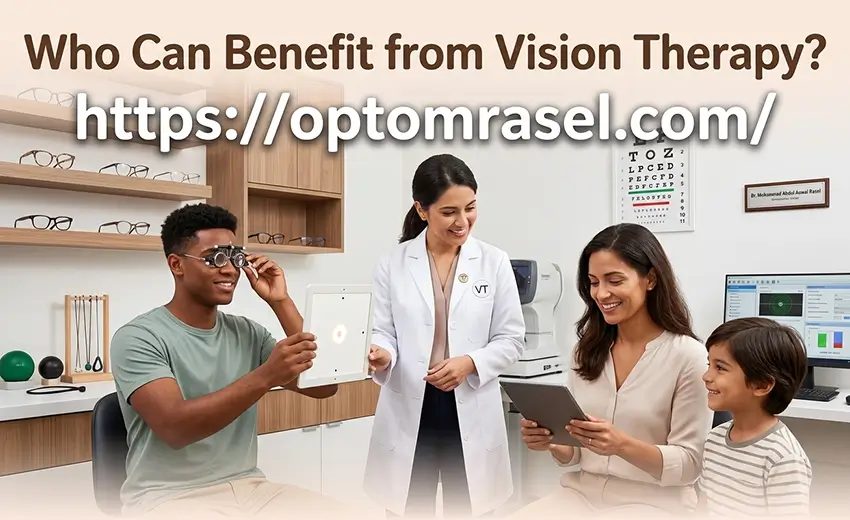
Who Can Benefit from Vision Therapy?
Vision therapy is not limited to children or to people with poor eyesight. A wide range of patients benefit from this treatment, including those with perfectly normal visual acuity (20/20 vision) who still experience significant visual discomfort or functional difficulties.
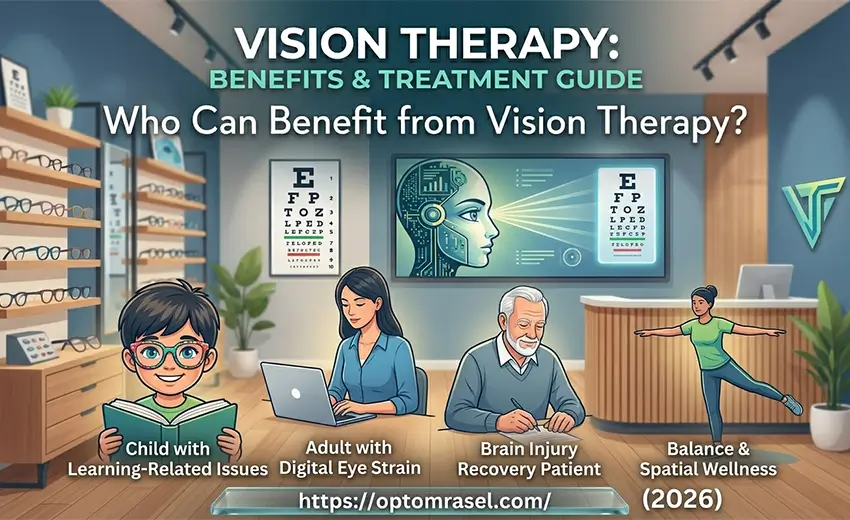
Children with Learning-Related Vision Problems
Many children diagnosed with learning difficulties, attention problems, or reading delays actually have undetected visual skill deficits. Poor eye tracking, reduced focusing stamina, or weak eye teaming can make reading exhausting and slow leading to avoidance, frustration, and academic underperformance.
A child who loses their place while reading, rubs their eyes frequently, tilts their head when looking at a page, or complains of headaches after short reading periods may be experiencing a treatable vision problem, not a learning disability.
Adults with Binocular Vision Disorders
Adults are not too old for vision therapy. Many adults live for years with symptoms such as eye strain after screen use, difficulty concentrating, headaches, or depth perception problems without realizing these are signs of a binocular vision disorder. Vision therapy can significantly reduce or eliminate these symptoms.
Patients Recovering from Brain Injury
Traumatic brain injury (TBI), stroke, and concussion frequently disrupt the visual system. Patients may experience double vision, difficulty tracking moving objects, visual field loss, or sensitivity to light. Neuro-optometric rehabilitation a specialized branch of vision therapy, helps these patients regain functional visual skills and improve their quality of life.
Common Conditions Treated with Vision Therapy
Vision therapy addresses a broad range of diagnosed visual conditions. The following are among the most frequently treated.
Lazy Eye (Amblyopia)
Amblyopia commonly called lazy eye occurs when one eye fails to develop normal visual acuity during childhood, usually because the brain begins to suppress input from that eye. Traditional treatment relied solely on patching the stronger eye, but modern vision therapy takes a more comprehensive approach. By training both eyes to work together, vision therapy produces better, more lasting outcomes than patching alone.
Eye Teaming Problems (Strabismus)
Strabismus is a condition where the eyes do not point in the same direction simultaneously. This breaks down normal binocular vision and can lead to double vision or suppression of one eye’s image. Vision therapy sometimes in combination with surgery helps train the eyes to align and coordinate properly.
Eye Tracking Difficulties
Smooth, accurate eye movement is essential for reading, driving, and sports. When the eyes jump, skip, or lose fixation during tracking tasks, reading becomes slow and effortful. Vision therapy exercises can substantially improve eye movement control, making these daily activities easier and less tiring.
Double Vision (Diplopia)
Double vision can result from misaligned eyes, muscle imbalances, or neurological conditions. Vision therapy, using prisms and targeted exercises, can help the brain resolve the conflicting images from both eyes reducing or eliminating double vision in many patients.
Convergence Insufficiency
Convergence insufficiency (CI) is one of the most common and most frequently missed binocular vision disorders. It occurs when the eyes struggle to turn inward together to focus on near objects, causing symptoms such as double vision, blurred near vision, headaches, and difficulty sustaining concentration. Research, including clinical trials funded by the National Eye Institute, has shown that in-office vision therapy is the most effective treatment for convergence insufficiency.
Vision Therapy Exercises
Vision therapy exercises are prescribed specifically for each patient’s condition. They are never a substitute for professional evaluation, but the following are commonly included in supervised programs. Do not attempt these as self-treatment without an optometrist’s guidance.
Pencil Push-Ups
Pencil push-ups are a standard exercise for convergence insufficiency. Hold a pencil at arm’s length, focus on a letter printed on it, and slowly bring it toward the tip of your nose. The goal is to maintain a single, clear image of the letter for as long as possible before it doubles. This exercise strengthens the eye’s ability to converge turn inward for near work.
How to do it: Repeat 10-15 times per session, twice daily, as directed by your optometrist.
Brock String Exercise
The Brock string is a classic binocular vision tool. It consists of a white string with colored beads at measured intervals. One end is attached to a fixed point and the other is held at the nose. When both eyes are working together correctly, the string appears to form an “X” shape at the bead being fixated. This exercise trains eye alignment and simultaneous use of both eyes.
How to do it: Fix your gaze on each bead in turn, moving from near to far, checking for the X pattern at each bead. Practice for 5-10 minutes daily.
Tracking Exercises
Smooth pursuit and saccadic eye movement exercises improve the ability to follow moving objects and shift gaze quickly and accurately between targets. These are especially helpful for children with reading difficulties and for athletes.
Example: Hold a small target (pen tip or printed letter) and move it slowly in horizontal, vertical, and diagonal paths while keeping your head still. Follow the target as smoothly as possible without losing focus.
Focusing (Accommodative) Exercises
Accommodative flexibility exercises train the eye’s focusing system to shift rapidly and accurately between near and distant targets. Reduced accommodative flexibility causes blur, eye fatigue, and difficulty copying from a board.
Example: Hold a near card at reading distance and look at a distant target across the room. Alternate your focus between near and far on command, aiming for immediate clarity at each distance. Use flipper lenses if prescribed by your optometrist for greater challenge.
Vision Therapy Benefits
Patients who complete a full, supervised vision therapy program often report wide-ranging improvements in both their visual function and their quality of life.
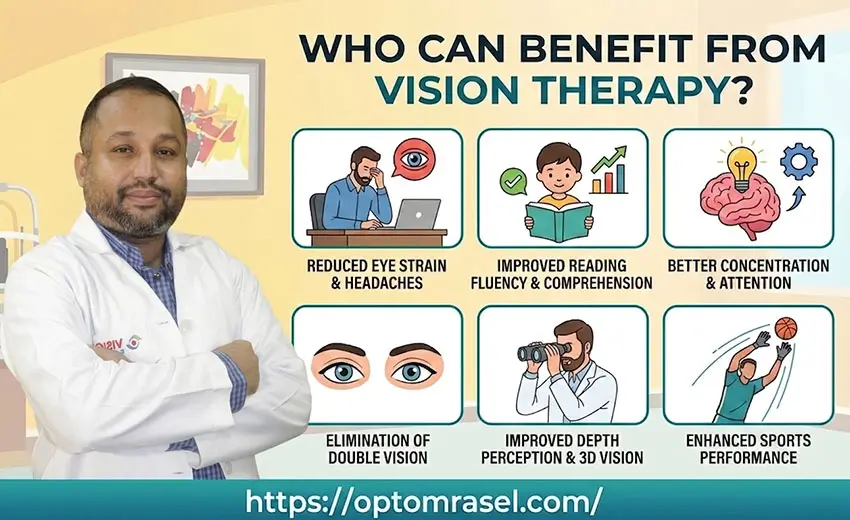
- Reduced eye strain and headaches particularly after reading or screen use
- Improved reading fluency and comprehension: children often show measurable academic gains
- Better concentration and attention span when vision is efficient, cognitive resources are freed up
- Elimination or reduction of double vision
- Improved depth perception and 3D vision
- Enhanced sports performance better tracking, reaction time, and hand-eye coordination
- Greater visual comfort during near work essential in today’s screen-heavy environment
- Improved self-confidence in children when learning becomes less of a struggle
Is Vision Therapy Effective?
The short answer is yes for appropriately diagnosed and properly managed conditions, vision therapy has a strong body of scientific evidence behind it.
The most rigorous evidence comes from the Convergence Insufficiency Treatment Trial (CITT), a large multi-site randomized clinical trial published in the journal Archives of Ophthalmology. The study found that office-based vision therapy with home reinforcement was significantly more effective than home-based pencil push-ups or placebo treatment for convergence insufficiency in children and adults.
Multiple studies also support vision therapy for amblyopia, with research showing that binocular approaches (training both eyes simultaneously) can improve visual acuity and stereopsis more effectively than traditional patching alone.
It is important to note that vision therapy works best when it is evidence-based, individualized, and supervised by a qualified optometrist. Programs that are rushed, poorly monitored, or not tailored to a specific diagnosis will not produce optimal outcomes.
Patient outcomes in clinical practice consistently mirror the research literature. Many patients including those who had tried other interventions without success report significant improvements in symptoms, daily functioning, and quality of life following a properly designed vision therapy program.
Vision Therapy for Children
Children are often the most responsive patients in vision therapy because their visual systems are still developing. The earlier a binocular vision problem is identified and treated, the better the outcome is likely to be.
Signs that your child may need a vision therapy assessment include:
- Avoidance of reading or near tasks
- Losing their place while reading or using a finger to track words
- Reversing letters or words beyond the expected age
- Squinting, closing one eye, or tilting the head when reading
- Complaints of headaches or tired eyes after schoolwork
- Short attention span for near tasks
- Performing below their academic potential despite apparent effort
- Poor hand-eye coordination or difficulty catching a ball
A comprehensive binocular vision evaluation separate from a standard school eye screening is needed to detect these problems. School screenings check only distance visual acuity and miss the vast majority of binocular vision disorders.
Vision therapy programs for children are usually engaging and activity-based, using games, interactive tools, and positive reinforcement to keep young patients motivated throughout the program.
Vision Therapy for Adults
A persistent myth in eye care is that adults cannot benefit from vision therapy. This is not supported by the evidence. The brain retains neuroplasticity throughout life, and adults respond well to vision therapy for many conditions including convergence insufficiency, accommodative disorders, binocular vision dysfunction, and acquired visual deficits following brain injury.
Adults seeking vision therapy often report years of unexplained symptoms chronic headaches, difficulty reading for extended periods, discomfort in visually demanding environments, or problems with digital screens that were never linked to a treatable visual problem.
Adults may require slightly more sessions to achieve comparable results to children, but the functional improvements reduced visual fatigue, better concentration, and improved work performance, are just as meaningful.
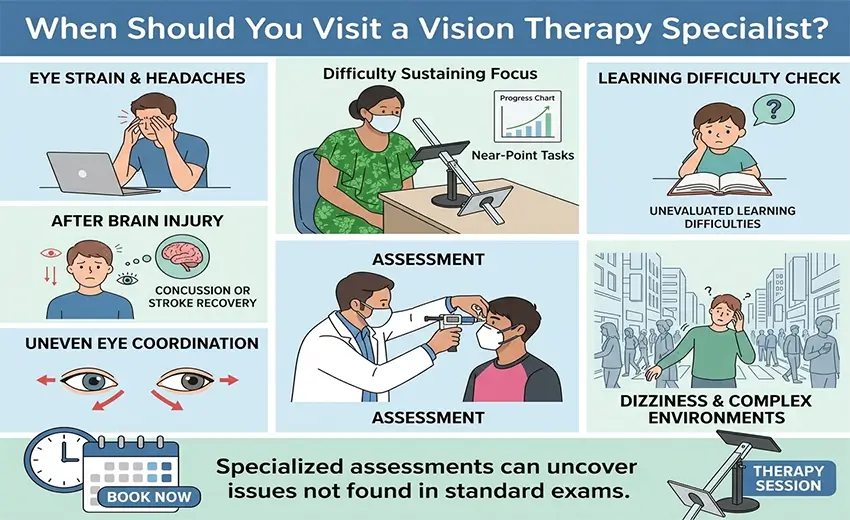
When Should You Visit a Vision Therapy Specialist?
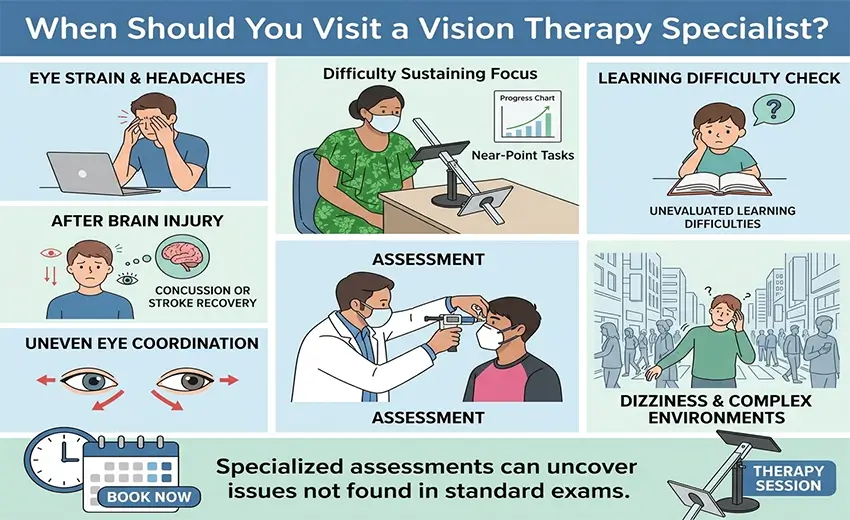
You should consider booking a vision therapy consultation if you or your child experiences any of the following:
- Eye strain, headaches, or fatigue during or after reading or screen use
- Double vision or blurred vision at near or far distances
- Difficulty sustaining focus on near tasks
- Words that appear to move or blur on the page
- Poor depth perception or difficulty judging distances
- A child who has been evaluated for learning difficulties but shows no clear cause
- Recovery from concussion, stroke, or traumatic brain injury with visual symptoms
- A diagnosis of amblyopia, strabismus, or convergence insufficiency
- Dizziness or motion sensitivity in visually complex environments
Even if you have recently had a standard eye exam and been told your eyes are “fine,” you may still benefit from a specialized binocular vision assessment. Standard eye exams do not always test the functional visual skills that vision therapy addresses.
Why Choose Dr. Mohammad Abdul Auwal Rasel for Vision Therapy in Bangladesh?
Finding an experienced, qualified vision therapy provider in Bangladesh can be challenging. Dr. Mohammad Abdul Auwal Rasel is one of Bangladesh’s most experienced clinicians in this specialized field, bringing a unique combination of skills and clinical depth to every patient he sees.
Clinical Experience You Can Trust
With 10 years of general optometry practice, 5 years of dedicated vision therapy practice, and 3 years of experience as an ocularist (artificial eye specialist), Dr. Rasel brings a comprehensive understanding of the visual system that goes far beyond routine eye care.
His experience as an ocularist a specialist in the fitting and fabrication of ocular prosthetics gives him an unusually deep understanding of orbital anatomy and the complete visual system, which informs his approach to complex cases in vision therapy.
Comprehensive Diagnostic Assessment
Every patient at Dr. Rasel’s practice begins with a thorough binocular vision evaluation that goes beyond standard visual acuity testing. This assessment evaluates eye alignment, convergence, accommodation, saccadic and pursuit eye movements, visual processing, and stereopsis providing a complete picture of how your visual system is functioning.
Personalized Therapy Programs
No two patients receive the same program. After diagnosis, Dr. Rasel designs an individualized treatment plan based on your specific deficits, your goals, your age, and your lifestyle. Programs are regularly reviewed and updated to ensure continued progress.
Patient-Centered Care
Dr. Rasel is committed to clear communication, patient education, and ongoing support throughout the therapy process. He takes the time to explain what is happening in your visual system, why the exercises work, and what progress you can realistically expect.
His practice serves patients across Bangladesh, including Dhaka and surrounding areas, and welcomes referrals from other healthcare providers.
Book a Vision Therapy Consultation
If you have been living with unexplained eye strain, reading difficulties, or visual discomfort or if your child is struggling at school without an obvious academic reason a vision therapy evaluation could be the most important eye appointment you ever book.
Do not wait for symptoms to worsen. The earlier a binocular vision problem is identified and treated, the better and faster the outcomes tend to be.
Take the next step today. Visit optomrasel.com to book your comprehensive binocular vision assessment with Dr. Mohammad Abdul Auwal Rasel. Appointments are available for children and adults, and detailed written reports are provided following every assessment.
Book your vision therapy consultation at optomrasel.com and start seeing the world more clearly.
Frequently Asked Questions About Vision Therapy
Vision therapy is a customized, supervised program of eye and brain exercises designed to improve visual skills such as eye coordination, focusing, tracking, and visual processing. It treats conditions that glasses or surgery alone cannot fully correct.
Yes. Adults can benefit significantly from vision therapy. The brain retains neuroplasticity throughout life, and adults respond well to treatment for convergence insufficiency, accommodative disorders, and post-concussion visual deficits. Some conditions respond best when treated early, but many adults experience meaningful improvements at any age.
The length of a vision therapy program varies depending on the condition being treated and its severity. Most programs run between 12 and 36 weekly in-office sessions. Some patients see improvement within weeks; others need several months of consistent practice. Your optometrist will give you a realistic timeline after your initial assessment.
Yes. Vision therapy is an effective treatment for amblyopia, particularly the binocular approach that trains both eyes to work together simultaneously. Research has shown that vision therapy produces better outcomes than patching alone in many cases, including in older children and adults who were previously told treatment was no longer possible.
Dr. Mohammad Abdul Auwal Rasel offers specialized vision therapy services in Bangladesh. You can book a consultation through his website at optomrasel.com. His practice serves patients in Dhaka and surrounding regions, and he accepts referrals from across the country.Dr. Mohammad Abdul Auwal Rasel offers specialized vision therapy services in Bangladesh. You can book a consultation through his website at optomrasel.com. His practice serves patients in Dhaka and surrounding regions, and he accepts referrals from across the country.Vision therapy is non-invasive and very safe when conducted under the supervision of a qualified optometrist. There are no known serious risks associated with properly administered vision therapy. Side effects are rare and typically mild some patients experience temporary eye fatigue during the early stages of treatment as the visual system adapts.
Vision therapy exercises include techniques such as pencil push-ups for convergence, Brock string for binocular alignment, saccadic tracking exercises for eye movement control, and accommodative flipper exercises for focusing. Exercises are prescribed individually not every patient performs the same routine. Home exercises are assigned to reinforce progress between clinic sessions.
Dr. Mohammad Abdul Auwal Rasel offers specialized vision therapy services in Bangladesh. You can book a consultation through his website at optomrasel.com. His practice serves patients in Dhaka and surrounding regions, and he accepts referrals from across the country.
The cost of vision therapy varies depending on the number of sessions required, the complexity of the condition, and the diagnostic tests involved. After your initial comprehensive assessment, Dr. Mohammad Abdul Auwal Rasel will provide a full outline of the recommended program and its associated cost. Most patients find the investment worthwhile given the lasting improvements in daily functioning and quality of life.
Yes children are often the best candidates for vision therapy because their visual systems are still developing, making them highly responsive to treatment. Vision therapy is recommended for children with amblyopia, convergence insufficiency, strabismus, eye tracking problems, and learning-related vision issues. The earlier treatment begins, the better the outcome is likely to be.
Vision therapy can treat a wide range of conditions including amblyopia (lazy eye), strabismus (eye turn), convergence insufficiency, accommodative disorders, eye tracking difficulties, double vision (diplopia), visual perceptual deficits, and post-concussion visual symptoms. A comprehensive binocular vision evaluation is required to confirm diagnosis and recommend the appropriate treatment program.
Conclusion
Vision therapy is a powerful, evidence-based treatment that addresses the root causes of many visual problems, not just their symptoms. Whether you are a parent concerned about your child’s reading difficulties, an adult struggling with eye strain at work, or a patient recovering from brain injury, vision therapy may provide the relief and improvement you have been searching for.
With an experienced vision therapy specialist like Dr. Mohammad Abdul Auwal Rasel, patients in Bangladesh now have access to world-class care close to home. His decade of optometry experience, five years of dedicated vision therapy practice, and unique background as an ocularist make him one of the most comprehensively trained eye care professionals available in the region.
Do not let a treatable visual problem continue to hold you or your child back. Book a vision therapy consultation today and take the first step toward clearer, more comfortable, and more efficient vision.
Visit optomrasel.com to schedule your appointment with Dr. Mohammad Abdul Awal Rasel